

















GAMP-Compliant AI Platform for Life Sciences & Regulated Industries
  • Low-code aPaaS
  • Careers
  • Low-code aPaaS
  • Careers

AmpleLogic PVS

Process Validation Software for Pharma Industries - AmpleLogic

Elevate Process Precision and Excellence

AI-Powered APQR Software

Annual Product Quality Reviews, Reimagined with AI

Annual Product Quality Review is a critical regulatory requirement for pharmaceutical and life sciences organizations. AmpleLogic’s APQR solution enables structured, compliant, and inspection-ready reviews by consolidating quality data, automating trend analysis, and generating audit-ready reports.

Trusted by 100+ Pharma Companies Globally

Why choose AmpleLogic Process Validation Software?

AmpleLogic Process Validation Software stands out as the ideal solution for validating complex manufacturing processes. Our state-of-the-art software ensures:

Electronic Signatures

Enables secure approval and verification of validation documents and processes

Real-time Monitoring

Monitors process parameters and alerts for deviations or issues

Advanced Integration

Integrates with ERP, QMS, APQR systems for automated data exchange

Risk Assessment and Management

Identifies and mitigates risks to ensure product quality and safety

AmpleLogic’s Process Validation Software empowers regulated industries like Life Sciences, Food & Beverages, Cosmetics, Gene Therapy, and Medical Devices to achieve unparalleled process accuracy and excellence. By keeping businesses on track, it ensures compliance, efficiency, and transparency in operations, setting new standards for industry performance.

Protocol Management

Enables creation, management, and tracking of validation protocols, with customizable templates for diverse processes

Data Collection and Analysis

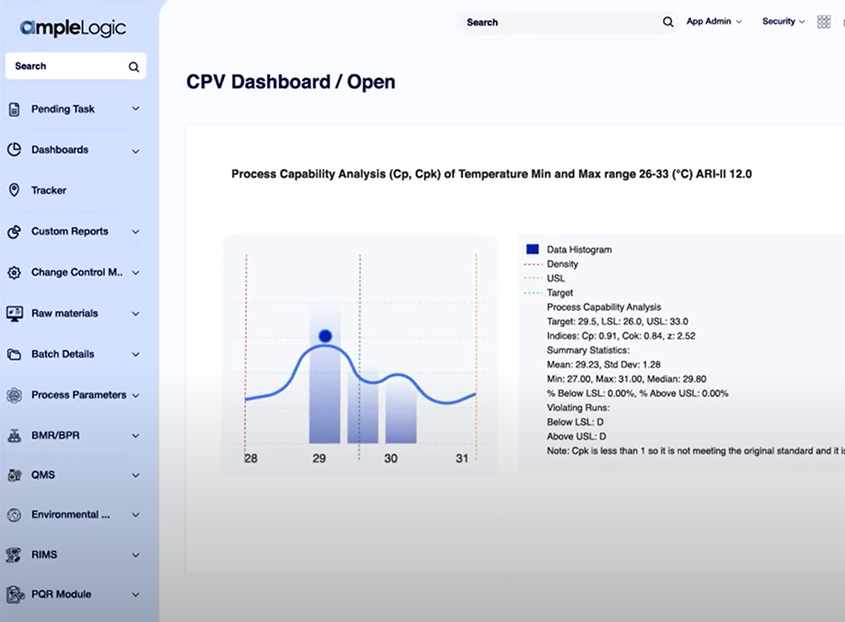
Streamlines data collection from diverse sources and offers analysis tools for ensuring process compliance

Document Management

Facilitates organization, storage, and retrieval of validation documents, including SOPs, batch records, and reports

Change Control

Manages process changes, ensuring compliance through evaluation, documentation, and validation

Pique Process Validation with AL’s Process Validation Software

Auto Protocol Drafting

Instant auto protocol drafting as per SOP (standard operating procedure).

Audit Trail

Tracks all system changes and activities, ensuring data integrity and regulatory compliance.

Validation Reporting

Generates smart reports with data visualization and predictive analysis summarizing validation activities, results, and conclusions for regulatory submissions.

Compliance Assurance

Maintains regulatory compliance with FDA-compliant adherence to 21 CFR Part 11 and other industry standards.

Version Control

Implements version control for documents and procedures to systematically track changes, revisions, and approvals.

Training and Competency Records

Maintains records of employee training and competency assessments to ensure a skilled and compliant workforce.

Equipment Integration

Integrates seamlessly with equipment such as HPLC, balances, machines, and other laboratory instruments.

Verification

Validates resources such as equipment, rooms, and solutions before usage to avoid noncompliance.

Version Master Plan Automation

Automates Version Master Plan (VMP) schedules for process validation.

Workflow Automation

Streamlines approval workflows, enhancing accuracy and efficiency of data entry and validation.

User-Friendly Interface

Intuitive interface that simplifies logbook and validation management for users at all levels.

Controls and Monitors CPP & CQA

Helps organizations meet Critical Process Parameters (CPP) and Critical Quality Attributes (CQA).

Industries We Serve

Industry-Specific Software for Enhanced Quality and Compliance

Life Sciences

Apply Nelson Rules to detect abnormal process behaviour and statistically significant trends.

Pharmaceuticals

Ensure consistent and inspection-ready APQR execution aligned with regulatory requirements.

Medical Devices

Transform the medical device industry with software that enhances compliance.

Gene & Cell Therapy

Address the complexity of advanced therapies by capturing batch-specific data, deviations.

Food & Beverages

Conduct structured product quality reviews that support safety, consistency, and regulatory expectations.

Cosmetics

Maintain standardized APQR documentation and quality trend visibility to support regulatory.

Case Studies

FAQ’s

Get Answers to All Your Queries

Process validation software is a type of software designed to assist organizations in validating and monitoring their manufacturing processes. These processes can range from pharmaceutical production to food processing to automotive manufacturing. The software helps ensure that these processes consistently produce products that meet predetermined quality standards and regulatory requirements.

A Process Validation Software facilitates the automation and optimization of validation procedures within manufacturing, ensuring consistent adherence to quality and regulatory benchmarks.

What sets AmpleLogic’s Process Validation Software apart?

AmpleLogic extends its solutions to regulated industries such as Life Sciences, Food & Beverages, Cosmetics, Medical Devices, among others.

Our Process Validation Software is meticulously crafted to align with international standards prescribed by regulatory bodies such as the US FDA, EMA, MHRA, and others.

The Food and Drug Administration (FDA) of the United States provides a document known as FDA Form 483 following an inspection. It lists any possible infractions or problems that were discovered when reviewing a company’s procedures, including production, quality control, and documentation. Process validation software is used, particularly in the pharmaceutical and medical device industries, to make sure that production processes fulfill FDA regulatory standards for creating safe and effective goods.

If the FDA discovers difficulties with a company’s use of software to validate procedures (such as incomplete testing or mistakes in data documentation), it may issue a Form 483 outlining the precise flaws. Businesses must make sure their software conforms with FDA regulations, which include electronic records and signatures (21 CFR Part 11), in order to prevent this.